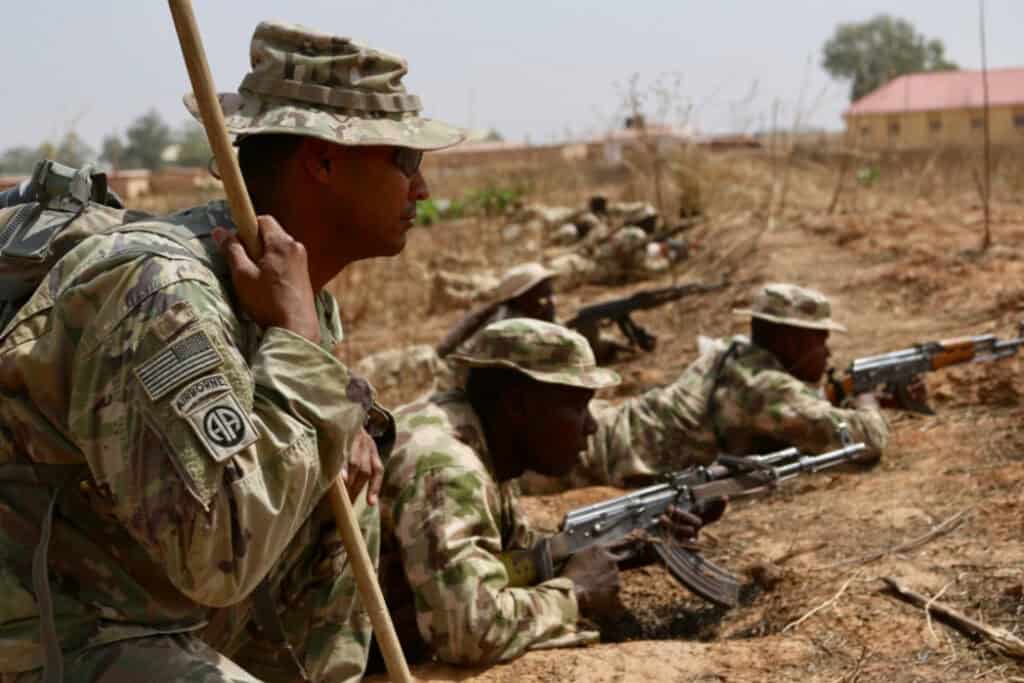
The U.S. military and Nigeria’s Armed Forces killed Abu Bilal al-Minuki, a senior Islamic State figure, along with several other commanders during a joint operation in northeastern Nigeria on May 16. According to U.S. Africa Command (AFRICOM), al-Minuki served as ISIS’s “director of global operations” and was regarded as the group’s second-highest-ranking leader. (africom.mil)
AFRICOM said its preliminary assessment indicated that several militants were killed in the operation, including Abu Bilal al-Minuki, ISIS’s director of global operations, along with other senior leaders. The Islamic State has yet to respond to reports surrounding Minuki’s death.
U.S. Air Force General and AFRICOM commander Dagvin Anderson said the operation that resulted in the deaths of Minuki and other Islamic State leaders was carried out through months of close cooperation and coordination between U.S. and Nigerian forces. He added that both countries remain determined to aggressively target and eliminate terrorist threats while safeguarding their citizens and national interests.
The Trump administration has urged the Nigerian government to intensify efforts against the Islamic State. On December 25, 2025, the U.S. also carried out a strike against the Islamic State West Africa Province (ISWAP) in response to the group’s attacks on Christian communities in Nigeria.
Islamic State’s number two?
Both President Donald Trump and AFRICOM described Minuki as the Islamic State’s second-in-command, though analysts monitoring ISWAP have expressed doubts about that claim.
AFRICOM said Minuki played a key role in advising the Islamic State’s global network on media and financial activities, as well as the production and development of weapons, explosives, and drones. The command also described him as one of the world’s most active terrorists, citing his extensive involvement in orchestrating attacks and overseeing hostage-taking operations.
Despite U.S. claims that Minuki was the Islamic State’s second-in-command, he had not previously been publicly identified as the group’s deputy leader. In its February 2026 global terrorism report, the United Nations Analytical Support and Sanctions Monitoring Team described Minuki as the head of the Islamic State’s Al Furqan office — one of several regional offices created to help coordinate the group’s international operations and channel funds to its affiliates worldwide. The Al Furqan office is responsible for overseeing much of the Islamic State’s activities across the Sahel, broader West Africa, North Africa, and Sudan.
The UN Monitoring Team stated that some countries believed Minuki had taken on a greater role within the Islamic State’s global leadership, with some suggesting he may have become head of the group’s General Directorate of Provinces (GDP). The GDP oversees and coordinates the activities of the Islamic State’s 12 provinces worldwide.
If Minuki did indeed lead the GDP, he would have occupied a position within the Islamic State’s highest leadership ranks. Some analysts consider the head of the GDP to be the group’s second-most influential role. Even so, Minuki had not previously been publicly identified as the Islamic State’s global deputy leader.